
Thornton Hall plans to bring planetarium to the 21st century
Hagar Planetarium will experience updated renovations after receiving close to $2 million in funding
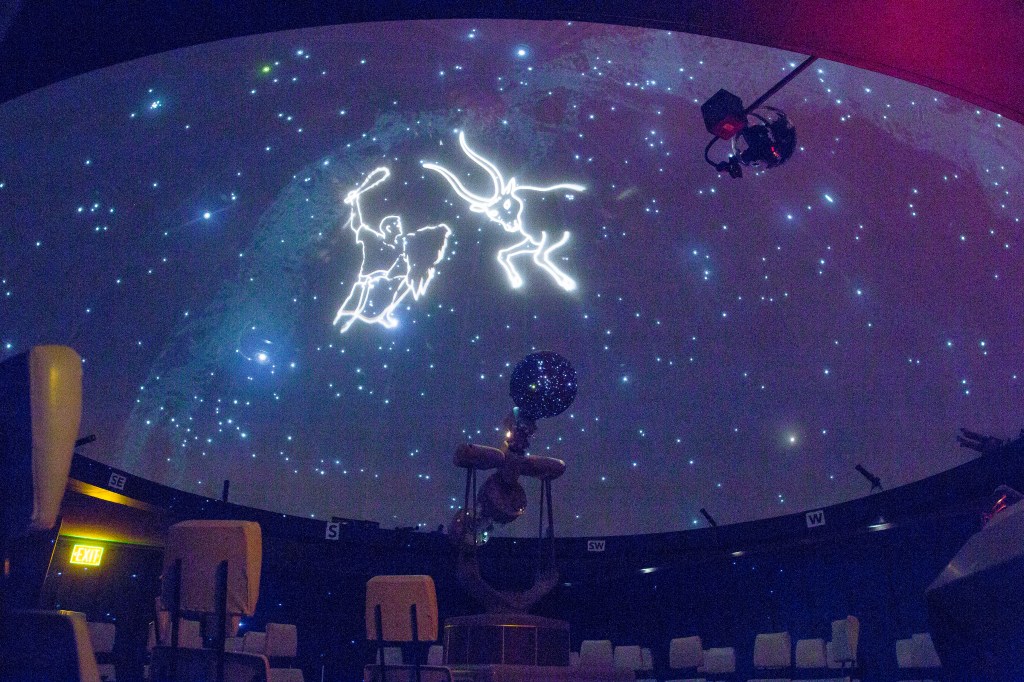
The planetarium in Thornton Hall displays several constellations and a night sky. (Courtesy of Paul Asper)
About 20 attendees, a mix of faculty and students, sat in a planetarium that reflected its half-century-old age. Gillis Lowry, an astronomy graduate student, cranked the squeaky knob of the control panel to change the years of the projector while observers’ seats creaked when they leaned back in their chairs during Monday’s planetarium show in Thornton Hall.
Soon, the San Francisco State University community can attend shows in a more modern venue.
Starting Feb. 26, 2026, Charles F. Hagar Planetarium will undergo renovations to update the space from its 1973 technology to a state-of-the-art design. The renovation will take several months, with public programming beginning in 2027.
In 2018, Hagar Planetarium and observatory director Adrienne Cool began efforts to renovate the planetarium and raise $1.5 million to provide it with new equipment.
At the end of 2023, the Heising-Simons Foundation informed Cool that her proposal for funding had been accepted, with the foundation committing the entire $1.5 million to the planetarium.
“It became obvious to us pretty quickly what an amazing asset the planetarium has been, not only for SF State, but the larger Bay Area,” said Jochen Marschall, director of the Heising-Simons science program. “It serves so many functions so well — as a unique teaching facility for SF State students, a training ground for the next generation of STEM educators, a resource for local schools, teachers and students and a powerful tool for bringing science to the community.”
In March, the planetarium received an additional $450,000 donation from the foundation, bringing the total investment to $1.95 million. Renovations will include replacing the projector, seats and control panel with new software coming from OpenSpace and a new Zeiss projector.
OpenSpace, is an open-source interactive data visualization software funded in part by NASA that is designed to visualize the universe. NASA will also provide the planetarium with full-dome video technology.
“We will be able to take you to different planets, see the sky from there and also give you a sense of the vastness of the universe,” said Lowry. “We’ll be able to do a zoom out from the earth and show you how tiny our solar system is compared to the galaxy and how tiny our galaxy is compared to the entire vastness of space.”
Jim Gibson, the astronomy laboratory, planetarium and observatory technician, compared the age of the current technology to movies that came out in the early ‘70s.
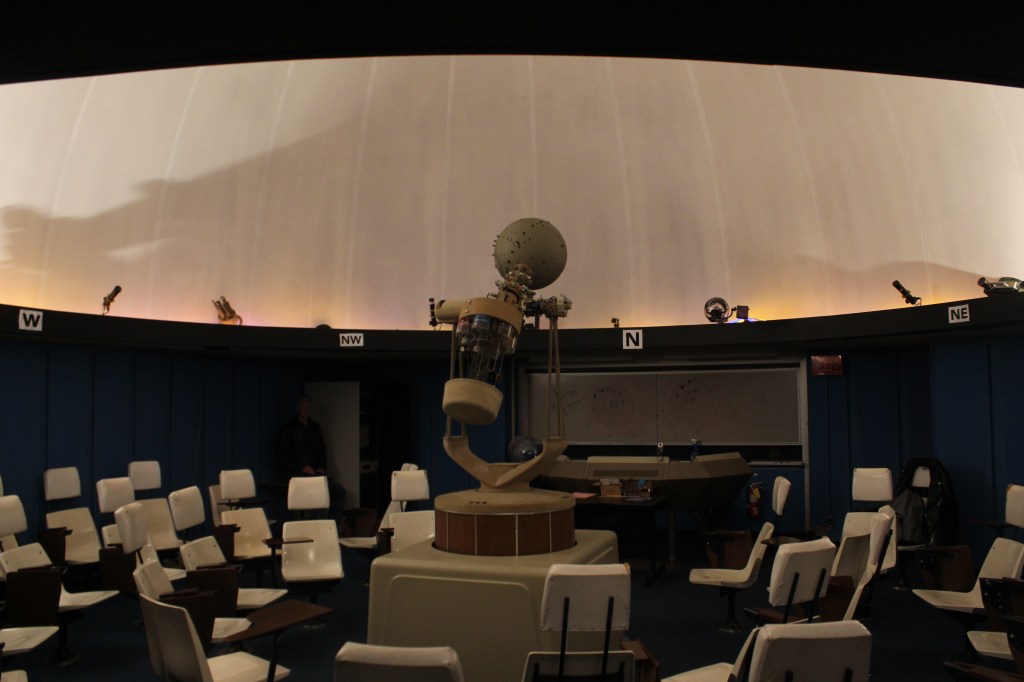
The planetarium in Thornton Hall after a canceled show on Nov. 7, 2025. (Paul Singh / Golden Gate Xpress)
“This thing [the projector] showed up the same year that Roger Moore was still running around being with James Bond,” Gibson said. “Roger Moore has gotten on in years, and so is this.”
Currently, there is no digital technology in the planetarium. Cool compared the technology to old typewriters, but that will change with the new projector.
“You can just punch in, ‘Let me go to the year 1953, and April 2nd.’ Boom, and we can be right there,” Cool said. “So [it’ll be] pretty different.”
According to Lowry, the biggest issue facing the planetarium is the fact that the projector does not display what year is showing, so operators can’t accurately set the moon and planets to today’s positions.
“There used to be a little counter here that would tell you the year and the month you’re on,” Lowry said. “Now we can only set the month using the ecliptic.”
Other plans for the renovation include adding track lighting at the entrance and addressing issues with the slide projector screens, seating and lights that display the planets.
“Some of the seats have, in the past, [been] broken, so students can’t lay backwards in them,” said astronomy lecturer faculty Katie Kooistra. “The projector is creaky and old and makes noises when it moves.”
Since its opening in 1973, the planetarium has served approximately 100,000 people, with an estimated 1,800 people visiting annually. SFSU physics and astronomy students mainly visit the space, but more than 1,000 students, faculty and staff from outside the department, community members and local K-12 students visit each year, according to an announcement from University Development.
Astronomy classes such as ASTR 116: Astronomy Laboratory and ASTR 301: Observational Astronomy Laboratory are taught in the planetarium. The department will have to find classroom alternatives while the space undergoes renovations.
“We were able to come up with other activities to do during lockdown when we weren’t on campus,” Kooistra said. “I imagine we’ll be doing similar things trying to schedule lab if we have to miss whole semesters’ worth of time in the planetarium. So I don’t know the exact plan, but there are other ways to do astronomy labs without the planetarium, if need be.”
Noche de Estrellas, a student-run program, has used the planetarium to host a series of short shows that alternate between Spanish and English. The club will be inactive until Fall 2026 and will do club meetings without the planetarium until renovations are completed, according to John Brewer, an associate professor of exoplanetary science.
Biology student Andrew Brownell had come to the planetarium for an endocrinology assignment, but is also interested in astronomy. He said he would come back once the renovations are completed.
“I think you can just tell that a lot of it’s outdated and it’s not as immersive as it could be,” Brownell said.
Charles Hagar was a professor in the physics and astronomy department from 1959-1994 and designed all the astronomy-related facilities in Thornton Hall.
“When this place first went up, I’m sure it was really incredible. Obviously, I was never able to see it, but Charles Hager, that the planetarium is named after, I’ve heard he did a really great job… a really fantastic show,” Lowry said. “So it’s great to be following in his footsteps like that and to be able to. Now that this technology has started to get to the end of its life, to be able to update it and continue to give the next generation a great set of shows.”
There will be six more 45-minute shows every Monday and Friday starting at 1 p.m. until renovations begin.
 Paul Singh Portfolio