
South Korean Missile Crashes After Test Launch in Brazil
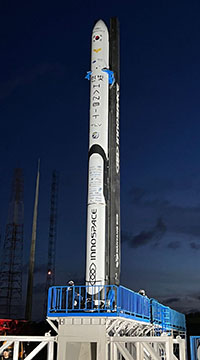
A missile by South Korean startup company Innospace
A missile by South Korean startup company, Innospace, has crashed during a launch in Brazil. After a minute of the missile being launched, the missile came crashing back to Earth. The launch was pushed back several times due to technical issues.
The missile is called Hanbit-Nano and it is a two-stage small satellite launch vehicle generated by 25 tons of thrust while burning liquid oxygen and paraffin. It is meant for the small sat market.
According to Space.com, a premier source of space exploration, innovation and astronomy news, “The rocket is designed to deliver up to 198 pounds (90 kilograms) of payload into a sun-synchronous orbit from Brazil. On the debut launch, the Hanbit-Nano was carrying five small satellites for customers from Brazil and India, as well as three additional technology-demonstrating payloads.”
The rocket seemed to have passed Max Q or maximum dynamic pressure before crashing down to Earth shortly after the launch. That is referring to when an aerospace vehicle experiences maximum aerodynamic pressure caused by atmospheric density and increasing speed. The satellite was believed to be flying at speeds of Mach 1.
Reports claim that the missile exploded 30 seconds after a launch at 10:13 a.m, while ascending into the sky, there were flames captured on a live broadcast screen.
A youtube video shows the moment Hanbit-Nano was launched before broadcast was suspended. It was carrying five small satellites, supposed to be deployed into a 300-kilometre low Earth orbit.
In addition, Innospace`s stocks had plunged nearly 24%-29% after the crash.
This was supposed to be South Korea`s first successful collaboration mission with one from India and four client satellites from Brazil. This could have helped Brazil`s space program since due to a satellite launch that killed 21 people in 2003 at Alcantara Space Center, Brazil`s space program was pushed back. Brazil only has seven active operational satellites.
There were also geopolitical issues that contributed to space launch delays for Brazil as well. “Plans for foreign firms to resume satellite launches from Alcantara, located strategically near the equator, were delayed by geopolitical jockeying over the past decade, including competing offers to partner with the United States and Russia,” Reuters reported.
Innospace is a startup company that specializes with hybrid rockets that was founded in 2017 by Kim Soo-jong. The CEO of Innospace expressed his apologies for the crash in a letter to shareholders expressing regret for the failed launch. The Independent reports, “‘We are deeply sorry that we failed to meet the expectations of our shareholders who supported our first commercial launch,’ he stated.”
The company is determined to figure out the cause of the incident and results of the analysis will be shared later.
Previously, there were delays due to weather and technical issues with certain parts, such as the cooling-unit component, but Innospace launched Hanbit-Nano with an operational window after replacing a faulty component. It carried eight registered cargo, including satellites.
Next year, Innospace is planning a second launch of the small rocket in 2026. There were no injuries reported from the incident.
 Paul Singh Portfolio