
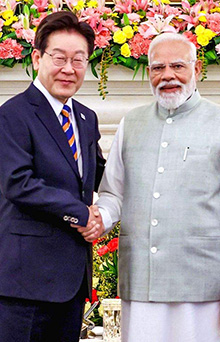
S. Korean President Lee Jae-Myung (left) meets with Indian Prime Minister Narendra Modi at Hyderabad House, guest house for dignitaries, in New Delhi on April 20, 2026. He was on his three-day state visit to India.
President Lee Jae-Myung and Prime Minister Narendra Modi of India have engaged in talks about shipbuilding and artificial intelligence. Other topics that will also be mentioned are trade, semiconductors, investments and emerging and critical technologies.
Between India and South Korea, trade grew at 3% from 2018 to 2025 ending March of that year by reaching $26.89 billion which is around ₩39,711,017,550,000.00. By 2030, their goal is to expand trade by $50 billion.
The two countries also signed 20 memorandums of understanding (MOUs) for deeper cooperation in steel, in addition to shipbuilding, energy and other sectors. In the forum, approximately 250 South Korean business leaders had attended the event with 350 Indian business leaders participating in the forum.
Specifically, from South Korea, business leaders included Samsung Electronics Chairman Lee Jae-yong, HD Hyundai Chairman Chung Ki-sun which specializes in heavy equipment, machinery, the petroleum industry and shipbuilding, LG Group Chairman Koo Kwang-moo, multinational steel-making company from Pohang POSCO Group Chairman Chang In-Hwa and Hyundai Motor Group Executive Euisun Chung.
Furthermore, from India, business leaders included President of the Federation of Indian Chambers of Commerce & Industry Anant Goenka, Vice Chairman Essar Group Ravi Ruia, which specializes in infrastructure, energy, retail, technology and metals and mining, Chairman of the Sanmar Group Vijay Sankar, which specializes in chemicals, shipping and engineering and the CEO of JSW Steel Jayant Acharya.
According to The Korea Times, “The memorandums include an initial agreement between HD Korea Shipbuilding & Offshore Engineering and India’s NSHIPTN and Sagarmala Finance to join forces for the construction of a new shipyard in India.”
Other technologies that South Korea and India plan on developing are anti-aircraft guns and missile systems. They both manufacture a specialised artillery gun called the K9 Vajra, which is a self propelled 155mm/52 calibre howitzer mounted on a 50-ton chassis with 19mm thick all-wielded steel armor.
The Indian army has deployed the K9 Vajra in Ladakh, which is located close to the border of China. They are also looking at other anti-aircraft guns and missiles to invest in.
“Lee and Modi will also discuss ‘continuing constructive cooperation for the sake of peace on the Korean Peninsula and within the region’, South Korea’s National Security Adviser Wi Sung-lac said in Seoul ahead of Lee’s state visit,” Channel News Asia reports.
Challenges that the two nations face are policy unpredictability and regulatory delays from South Korea companies investing in India. In addition, there is also trade uncertainty with the U.S. along with the drive to diversify away from China to make the two countries natural partners.
To promote mutual growth and innovation, President Lee plans on visiting India eight years later. India is a major market for South Korean conglomerates with Hyundai Motor listing a unit in the 2024 Indian stock market and seeking an annual production capacity of 1.5 million cars.
According to Reuters, “Companies such as Samsung Electronics and LG Electronics operate their manufacturing factories in India, with LG listing its Indian unit on the local stock market last year.”
After visiting India, President Lee also visited Vietnam. The heads of LG Group Chairman Koo Kwang-Mo, Hyundai Motor Group Executive Chair & CEO Chung Eui-Sun, Samsung Electronics Chairman Lee Jae-Yong and the SK Group Chairman Chey Tae-Won accompanied him for the Vietnam delegation.
President Lee traveled to Hanoi to meet with President To Lam of Vietnam to hold a summit discussing developing relations in global supply chains, critical minerals and energy. Last year in August, President Lam visited Seoul with the two countries agreeing to expand bilateral trade by $150 billion by 2030.
 Paul Singh Portfolio