
S. Korea’s Starbucks Stores Close Early for History Training after “Tank Day” Campaign
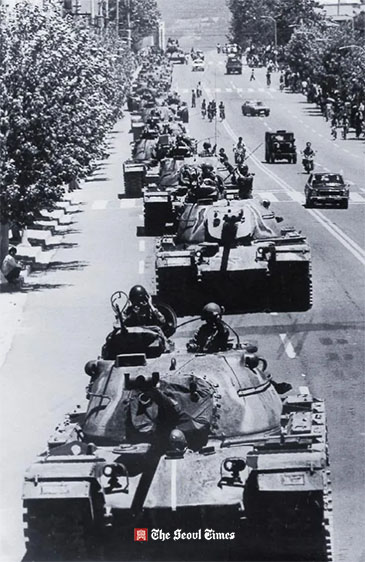
Tanks in Gwangju Massacre — A total of 606 people perished in and after the Gwangju Massacre in 1990 where Chun Doo-Hwan’s military trampled the people’s pro-democracy movement. Estimated 166 people died by the firing from the military in the incident and 65 were missing. The rest died of its aftermath.
Across South Korea, Starbucks stores are closing early for a history staff training after their disastrous “Tank Day” promotional campaign based on the 1980 massacre in Gwangju.
This promotional campaign received a lot of backlash as there were protests outside many Starbucks locations with protesters destroying many tumblers and mugs.
Starbucks staff will be engaged in “social sensitivity” training and watch recorded lectures on modern Korean history. Along with contemporary Korean history, the curriculum will be about how companies in their marketing decisions should account for social and historical insensitivities.
Training will cost the company 2.1 billion won which is 1.4 billion U.S. dollars. It will also be the first nationwide closure since Starbucks Korea opened in 1999.
South Korean politicians had also cut ties with the brand due to this campaign. President of South Korea Lee Jae-Myung had also called this move “inhumane.”
Prof.Jennifer Jung-Kim from the University of California Los Angeles said that Koreans are concerned with sensitivity when it comes to culture and history.
“‘Tank Day’ was a poorly thought out marketing strategy and one that rightfully angered many people and showed utmost disrespect for the long democratization process,” said Jung-Kim.
In addition, she also said that training the front-line employees is misleading responsibility for who approved the “Tank Day” campaign.
“Since the frontline employees are not the ones who came up with the tank day campaign, and they have the least power to go against the marketing campaign, training them seems a bit of misdirection,” Jung-Kim said.
Last month, their CEO, Son Jeong-Hyun was fired after the promotional event was halted within hours. The company then issued a public apology. Starbucks South Korea also had to issue an apology to the family of a student activist Park Jong-Cheol, who died of torture in 1987.
“Park had died after the investigator ‘hit the desk and he let out a gasp.’ It was later revealed that he had died by torture, and the lie about Mr. Park became a symbol of the brutality of the military dictatorship,” according to The New York Times,
Moreover, even celebrities would face backlash if they were seen at a Starbucks store. Musical actor Jung Min-Chan had to step down from the musical “Diaghilev” after he was seen drinking a Starbucks beverage inside a store.
Jung had to make an apology on Instagram stating “I sincerely apologize for causing discomfort and disappointment to many people due to my recent social media post.”
In addition, Shinsegae said that the five employees who were involved in this marketing campaign were also let go and there was no evidence that marketing employees were mocking the pro-democracy movement on purpose.
This is not the first time that a South Korean company has faced massive backlash trying to trivialize the Park case. In 2019, a fashion platform, Munsinsa ran an advert for fast and drying socks saying “when we slammed the desk they went ‘ugh’ and dried.” the End
 Paul Singh Portfolio