
Hardly Strictly Bluegrass Enhancing Diversity in Music Line-Up
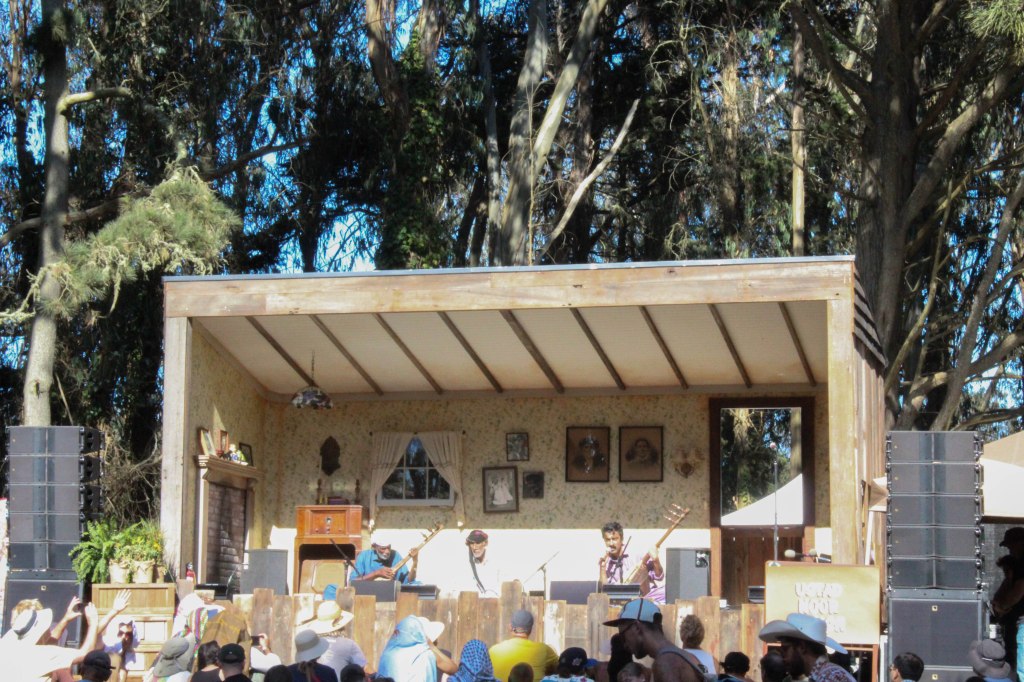
Ustad Noor Bakhsh performing at the Horseshoe Hill Stage on Oct. 6, 2024. (Photo by Paul Singh)
Among Hardly Strictly Bluegrass, we are seeing a few more diverse music artists performing. There is a band from Ukraine, a Pakistani music artist along with a couple other artists playing world music in a Bluegrass venue.
Apart from Ustad Noor Bakhsh and Dakha Brakha, Hardly Strictly Bluegrass showcases other types of world music such as when and where to catch British Afro-funk band Ibibio Sound Machine perform. Their tweet states, “Today on the Towers of Gold Stage: Ibibio Sound Machine 1:55 PM.” Ibibio Sound Machine is a band/group that consists of four African members from Ghana, Brazil and three Caucasian members.
Ustad Noor Bakhsh is a Pakistani musician from Balochistan, in the southwest bordering Iran and Afghanistan to the north. Noor Bakhsh plays an instrument called a benju which is used to play southern Pakistani music, specifically Balochi and Sindhi music. It is a string instrument that has a keyboard fitted on to it.
This makes a significant impact on Hardly Strictly Bluegrass since his performance will be attracting an audience from the Bay Area`s Pakistani or Indian community.
Hardly Strictly Bluegrass tweet states, “Known for his mastery of the benju and the songs of his native Balochistan, Ustad Noor Baksh’s music brings deep and infectious delight wherever he plays, and we look forward to sharing that energy in the Park!”
Noor Bakhsh`s music is mostly instrumental. A famous tune of Noor Bakhsh is ‘Jingul’ which is about a small bird that was building nests inside his house.
Mahindra Singh, Sikh man from Indian side Kashmir who came out to support the Balochi artist said, “So I recently heard Ustad Noor Bakhsh play and I`m just blown away by his genre, the kind of things he plays, and is bringing the folk music to the public which is a blessing for all of us.”
DakhaBrakha is a musical quartet from Ukraine formed in 2004. Hardly Strictly Bluegrass tweets, “We’re so excited that Ukraine’s own DakhaBrakha will be back with us this year, and we think you are too! Please join us in extending them a big welcome back!”
Since DakhaBrakha is playing at Hardly Strictly Bluegrass, it will have a significant impact on the Bay Area’s Ukrainian community. Their performance represents Ukrainian music such as combining elements of Ukrainian and Western instruments.
First time listener of the band, Machine Gun Guam from Rhu, Scotland said, “They`re very original. My mate told me. My mate told me yesterday he saw them here seven years ago and said they were picked up. They were picked up together in Ukraine from four different folk band and put together as a band and they`re absolutely fantastic.”
Apart from their homeland, DakhaBrakha has played in countries in Europe and South America, United States, Ireland, Australia and New Zealand.
One tune by DakhaBrakha to listen to is ‘A Lump in your throat’ that talks about the current situation in their motherland. Another tune to listen to is ‘Baby’ which is a love song.
“They`re folk, but they also have music that`s like techno and songs that are different genres or fit into different genres,” Lauren Roeden from Queens, New York said.
At the venue, the front is very crowded making it hard to find a place to walk around or sit, while towards the back it is more spacious. There were lots of families, college students and dogs.
“We should be having folk music from all over the world, you know, Indonesian gamelan. We should be having sitar music. You know there is a lot of great Eastern European folk music as well,” Basset hound owner Aaron Cundy said.
The temperature during the day was 85 degrees Fahrenheit. During the festival, no one was wearing sweaters and hoodies and some people were not wearing a shirt. There were a lot of people such as college students, families, and hippies dancing and enjoying the festival.
Combining the “typical” bluegrass music with more diverse sound such as the Balochi/Sindhi benji from Pakistan, Ukrainian folk music has attracted broader audiences.
Hopefully more types of sounds from other parts of the world, such as the gamelan from Indonesia representing the San Francisco Indonesian community, sitar and dhol from India further representing the South Asian community in the Bay Area and Chinese string instruments like the erhu and pipa that will represent San Francisco’s Chinatown will be included in the future line-up.
Overall, the diverse line-up has attracted more people to the venue. San Francisco is a very diverse city making the growing diverse line-up attracting more audiences. This will further popularize the music venue.
 Paul Singh Portfolio