
Bangladesh’s First Female Prime Minister Passes Away at Age of 80
“Mother of Democracy” Dies of Failing Health
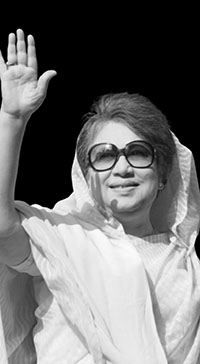
The late Khaleda Zia, Bangladesh` first female Prime Minister
Khaleda Zia, Bangladesh` first female Prime Minister who served from 2001 to 2006, has passed away at the age of 80 after struggling with multiple health issues like advanced liver cirrhosis, heart problems, diabetes and arthritis. She was 80 years old.
Zia was in hospital for treatment but her condition was deemed “extremely critical” before her passing at Evercare Hospital in Dhaka, the capital of Bangladesh. In 2021, she had tested positive for COVID.
There was even hope that she would run again for elections. According to BBC News, “Despite her poor health, her party had earlier said that Zia would contest general elections expected in February, the first since a revolution which led to the ousting of Zia’s rival, Sheikh Hasina.”
Even though they were political rivals, Hasina had also expressed her condolences for the loss of Zia.
“Exiled former Bangladesh Prime Minister Sheikh Hasina on Tuesday expressed condolences over the death of Bangladesh Nationalist Party (BNP) chairperson and former prime minister Begum Khaleda Zia, describing her passing as a major loss to the country’s political life,” Hindustan Times reports.
Her political history goes back to when Bangladesh gained its independence from Pakistan in 1971.
“Ms. Zia, the widow of the first of several military rulers in Bangladesh’s turbulent 50-year history as an independent nation, served two full terms and one shortened term as prime minister,” The New York Times reported.
Zia was also known as the “Mother of Democracy” in Bangladesh after the country was under a military coup by Army Chief Hussain Muhammed Ershad, who seized power against Abdus Sattar on March 24, 1982, imposing martial law and suspending the constitution and dissolving the parliament and council of ministers.
Ershad was serving as President of Bangladesh from 1983 to 1990 and was a member of Bangladesh`s political party that he founded, the Jatiya party. During this time, she resisted state-managed elections and endured house arrest since she was an opposition candidate to this rule.
In addition, after Ershad`s regime was overthrown in 1990, in 1991 she was sworn in as Prime Minister of Bangladesh representing the Bangladesh National Party (BNP) under a caretaker government. She had restored the parliamentary system in the country.
She had one of the strongest campaigns in the country. When she was contesting seats in five cities in Bangladesh like Khulna, southwest of Dhaka, Feni which is close to the border with Northeast India, Chattogram, formerly Chittagong, on the coast, Lakshimipur, west of Chattogram and Dhaka, she was successful in her campaign.
After Zia stepped down from her second term as Prime Minister in 2006, the country went into political unrest resulting in not only the arrest of Zia but also Sheikh Hasina as well on corruption charges.
In 2018, Zia had returned to politics on cases of political corruption, when a public figure uses their position for dishonest personal gain, but she claimed it was politically motivated by the BNP and Zia.
She was born on August 15, 1945 to the Majumder-Zia family which is one of the most influential political families in Bangladesh. She married an independence leader Zia-ur Rahman, in 1959 when Bangladesh was a part of East Pakistan and in 1971 she was under house arrest.
After his assassination in 1981, she started to become more politically active and took leadership of the Bangladesh National Party in 1984.
 Paul Singh Portfolio