
Armenia and Azerbaijan Have Signed a Peace Deal by US President
Paul Singh
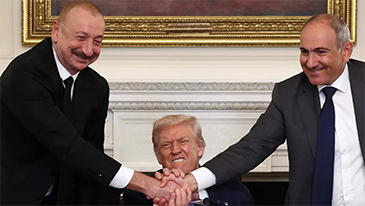
After years of fighting, the two caucasian nations located between Eastern Europe and Western Asia, Armenia and Azerbaijan have signed a Peace deal by the U.S. President Donald Trump. In the White House, Trump made a speech with President of Armenia Nikol Pashinyan and President of Azerbaijan Ilham Aliyev to sign a deal that proposes a bridge between Armenia and Azerbaijan`s western province Nakhchivan, which borders Iran and has a small border with Turkey.
This is a part of Russia`s declining influence in the Caucasus which is an opportunity for the U.S. According to the Associated Press, “The two countries in the South Caucasus signed agreements with each other and the U.S. that will reopen key transportation routes while allowing the U.S. to seize on Russia’s declining influence in the region. The deal includes an agreement that will create a major transit corridor to be named the Trump Route for International Peace and Prosperity, the White House said.”
Armenia had also given developmental rights to the U.S. for nearly an entire century. The Bulwark , a news site founded in 2019 reports, “Under the deal, Armenia also pledged to grant the U.S. exclusive development rights for 99 years, enabling rail,
energy, and digital connections.”
CNN reports that this is a part of President Trump`s plan to end wars across the world with the motivation of winning the Nobel Peace Prize.
Russia`s Declining Influence in the Caucasus Russia`s influence is declining in the Caucasus due to the 2022 war with Ukraine with the West maintaining “a limited role” in that region, along with the second Karabakh war in two years earlier, their regional influence “has diminished significantly” but they exploit frozen conflicts, give rise to domestic unrest and go after hybrid operations to weaken incumbent national authorities in order to maintain influence, according to the Royal United Services Institute.
Recently, Azerbaijan`s relations with Russia had started to decline with arrests of citizens from both countries. Carnegie Russia Eurasia Center reports that relations between the two countries “have unexpectedly become unprecedentedly strained” after several ethnic Azerbaijanis were arrested for a series of murders that took place 30 years ago, with men being beaten in detention centers resulting in two brothers, the main suspects, dead. This prompted a strong response from the capital city Baku.
There have also been Russian cultural events being cancelled in Azerbaijan along with Russia`s news agency, Sputnik, their office in Baku being raided by Azerbaijan authorities arresting employees and IT specialists, Carnegie Russia Eurasia Center states.
Russia had historically ruled that region in Eurasia. “For over 150 years, Russia ruled the South Caucasus, the mountainous region between Europe and Asia, through exploitation, domination and a colonialist divide-and-conquer policy,” according to The Hill.
Iran Rejection of the Peace Deal
Iran rejected the Peace deal with Armenia and Azerbaijan by President Trump threatening to block the Trump Route. “Iran has said it will block a corridor planned in the Caucasus under a United States-brokered peace accord between Azerbaijan and
Armenia, which has been hailed by other countries in the region as beneficial for achieving lasting peace,” Al Jazeera reports.
The reason Iran rejects this Peace Deal is because they do not think there should be foreign interference in the South Caucasus. “The ministry’s position reflects Tehran’s attempt to balance diplomatic engagement with strategic opposition, stressing that any regional projects must proceed “within the framework of mutual interests, with respect
for national sovereignty and territorial integrity, and without foreign interference,” the Jerusalem Post reports.
Georgia welcomes the Peace Deal
Neighboring Armenia and Azerbaijan, the country Georgia had welcomed the Peace deal with Prime Minister Irakli Kobakhidze describing this as “the beginning of a new era of stability and economic development,” Euronews reports.
Possible Interference from Russia
There is a possibility that Russia might interfere with Armenia-Azerbaijan relations. Middle East Eye, a UK news site with focus in the Middle East and North Africa, reports, “Some speculated that Moscow could take steps to undermine respective governments or try to engineer coups in Armenia or Azerbaijan, both former Soviet republics.”
There is also the possibility of a Russian invasion in the South Caucasus. “Pro-Kremlin commentator Vladimir Solovyov was even more direct, warning that Russia might launch another “special military operation” in the South Caucasus, as it had done in
Ukraine, if Nato bases are established there,” according to Middle East Eye.
There is also the possibility of Russia seizing assets from Azerbaijan. According to Middle East Eye, “Moscow can also seize assets belonging to the Aliyev family and allied oligarchs in Russia. Among those watched closely are Azerbaijani-Russian
billionaires God Nisanov and Zarakh Iliev.”
A Brief about the Nagorno-Karabakh Conflict
The two nations have fought over a region called Nagorno-Karabakh/Artsakh. “Azerbaijan and Armenia fought over Nagorno-Karabakh, an ethnically Armenian enclave in Azerbaijan, in the 1980s and 1990s and violence has flared up in the years since,” BBC reports.
After the war ended, Azerbaijan lost some of their territory to Armenians along with recognizing them as a third party. According to the Association for Diplomatic Studies & Training, “By May 1994, the Armenians were in control of 14% of the territory of
Azerbaijan. At that stage, for the first time during the conflict, the Azerbaijani government recognized Nagorno-Karabakh as a third party in the war, and started direct negotiations with the Karabakh authorities. As a result, a cease-fire was reached on
May 12, 1994 through Russian negotiations. Unfortunately, tensions heated up yet again in April 2016 when Azerbaijan claimed to have killed and wounded more than 100
Armenian soldiers.”
Five years ago, a war broke out in that region, which would have been the second war Armenia fought with Azerbaijan since their first conflict in 1993. “The last major escalation in the conflict took place in 2020 when thousands of people were reported
killed in six weeks of fierce fighting,” according to BBC.
Then in 2023, Armenian Prime Minister Nikol Pashinyan and Azerbaijan President Ilham Aliyev met in front of Putin to discuss the issue of Nagorno-Karabakh but they started arguing and interrupting with each other. Moreover, in the same year, the region that had been self-governed Armenians living there, Nagorno-Karabakh or Artsakh fell.
The Nagorno Karabakh conflict was caused by former leader of the Soviet Union Joseph Stalin when he was the acting Commissar of Nationalities of the USSR, the Bolsheviks took over Azerbaijan with Armenia and Georgia being taken over a year later. They promised to give Artsakh to Armenia for public support but to resolve tensions with Turkey, the Soviet Union gave Karabakh to Azerbaijan. Then in 1987, Karabakh Armenians signed a petition to be reunited with their homeland Armenia after the question re-emerged and tensions escalated toward the end of the USSR with a war breaking out in 1993 with casualties and refugees from both sides, according to ADST.
 Paul Singh Portfolio